Sunday, September 15, 2013

Christmas Race

Last night, a bunch of us took a break from studying, bought a few bottles of wine and went down to Piazza Maggiore - the main square in Bologna - to have an open air night. Public consumption is a-ok here and, as a student, I try to remind myself of that when others want to go to the bar. You can get a bottle of wine from the store for the same cost as a glass of wine at a bar. Plus, in the Piazza, you have a much nicer ambiance. Towards the end of the night, the natural competitiveness between us students came out and it was resolved through a foot race across one side of the square. It reminded me of how central "racing" is to my life. To some, a foot-race across an Italian square at midnight might sound like the result of inebriation, but I don't need encouragement for a head-to-head sprint.

I've found myself telling people more often about the tradition of the foot-race in my family. It's this tradition that my uncle started when I was a little kid - maybe five years old. My grandparents had a circular drive in front of their house that was about 50 yards in circumference. I don't remember a time in my life when the circular drive wasn't associated with running around it; specifically racing against my uncle.

I'm not sure if the first race was actually on Christmas day, but tradition quickly took hold and deemed that December 25th was race day. Running a race around the circular drive quickly became synonymous with the Christmas Day Race. Every year throughout my childhood, my uncle and I would approach the starting line (usually some sort of crack in the pavement) and run a lap around the circle back to the same point. As most activities involving uncle and nephew, he used it as an opportunity to torment me. He'd run shortcuts through the yard, run the opposite direction, hold the back of my shirt... all sorts of things. It wasn't too far removed from a Wile E. Coyote and Road Runner cartoon. Maybe that's where he got his inspiration. As we both got older, I got faster and he got slower. The race course got shorter, the finish-line less precise, and cousins got added to the mix. By the time I was in my late teens, it wasn't just me and my uncle running around the drive, there were four other cousins gunning for us. We started spending Christmas at other people's houses. My aunt's driveway served as the course one year - we abandoned all orthodoxy and even swam the short length of Barton Springs one year (although I think that one was technically Christmas eve).

One year my uncle introduced a new standard for victory: the winner was the one who demonstrated the most "horsepower", not the one who crossed the finish-line first. He weighed considerably more than me at the time and was clearly hedging his options in the likely case that he was not the first to cross the finish-line. He argued that the energy he expended during the duration of the race was considerably more than the energy I expended, and therefore evidence of his victory. The race was over in a matter of seconds, but I think the calculations and disputes over the result of that year's race are still pending today.

The Christmas Race, in other words, became much bigger than just a race. It was a yardstick that measured the increasing complexity of life as I got older. By the time I was seven, I knew to expect some kind of foul-play and would argue with my uncle over the validity of his short-cuts. This evolution in my critical thinking skills raised the ante and my uncle responded. He suggested that, to ensure cheating didn't affect the integrity of the Christmas Race, we draw up official rules to the execution of the race. This appeased me at the time because, as a seven year old, I associated rules with fairness. I made the fatal mistake of letting him be the rule keeper.

The result of that decision was a continuation of the same Wile E. Coyote tactics, but insistence from my uncle that they were permitted in the rule book. He wouldn't actually let me see the rule book (transparency was, apparently, not stipulated in the rule book) and within a year, I challenged him on whether the rule book even existed.

By the time I was in my early teens, the Christmas Race was essentially just the material for a year-long debate over the technicalities and legal philosophical approaches to judging the outcome of races. The following year's race would make sure to correct the injustices of the previous years, only to present a whole new set of perplexing questions after the race was run. For example, after the "horsepower" incident, we agreed from then on that the winner was definitely the one who crossed the finish line first. But then, the following year, my uncle gathered everyone Christmas morning and ran the race while I was in the bathroom. He won, apparently. I believe there was some collusion on the part of other family members that year, but that's beyond the point. Over the span of many Christmases running races against my uncle, the prestige and immaculateness of words like "fairness", "rules" and "spirit of the law" became heavily tarnished. I might be taking the parable of the Christmas Race a little far when I say this, but over the years, I realized that the creative capability of humans trumps our attempts to constrain them.

Of course, the Christmas Race had no real legal enforcement arm. We were operating in a state of anarchy where only our words and arguing skills could have possibly gotten us anywhere - and they rarely did. One year, when my cousin was about six, she decided that she would end all the bickering and reign as judge over the decision of who won the race. We both presented our cases for why we thought we won, pressured her to see it our way and within about five minutes, she was ran away crying. It just wasn't fair to her. I had had all those years of experience arguing with my uncle over who won the race. By the time she came along, the debate had evolved well passed the faculties of a six year old.

So really, I only share this story because it's come up a few times in the past week. In my Italian class, I had to tell the story as an introduction to my family. Also, my uncle has already started the trash talking (via email) for this year's Christmas Race. Just as an example, this year the taunting started with a suggestion from my uncle that all the tortellini I'm eating in Bologna will surely slow me down this year. I countered by pointing out that I'm running up mountains three times a week. My uncle responded by pointing out that long-distance running doesn't make you faster... you get the point.

But when I sat down to write this blog, it was last night's race across the piazza that stuck out in my mind. I realize now what was really so strange about it: I crossed the finish line first and that was it - no challenges, no appeals, no consultations with the spectators to get "their perspective of who won". The whole affair was just a little too straightforward for my taste. Although, I won't say I didn't enjoy the victory. 

Wednesday, September 4, 2013

What am I doing in Bologna, Anyways?

I just had my first exam in graduate school. We had a mid-term exam thirteen days and six lectures into my micro-economics course. It's no secret that this course is grueling (it compacts a thirteen week course into four weeks) but it still hit me pretty hard when I turned in the exam last night. I'm not sure if economics had ever got my heart-rate up as high as it was during the last five minutes of yesterday's exam.

But anyways, that's not the point of this post. Last time, I left off wanting to explain exactly what it is that I'm doing here.

Since 2007, I was working on conflict analysis for a private consulting/publishing company that covered a broad array of topics in international affairs. Because we were so broad and yet a relatively small team of analysts, we did a lot of cross-discipline work. As my own knowledge evolved there, I went from analyzing specific terrorist attacks, to looking at terrorist/militant groups in general to, trying to understand how those groups ultimately funded the operations that made the headlines.

I never quite got to the last step - or, never quite grasped it. I had studied organized crime enough to know that criminal groups, terrorist groups, separatist groups and all sorts of other nefarious, illegal operations use, for the most part, the same global financial networks that commercial banks and financial services companies use. My problem was that I didn't have much of a background in international economics and finance. I majored in International Relations as an undergrad, so I had taken an intro course to international economics, but that wasn't nearly enough to do what I needed. I tried to teach myself, learning about international financial transactions and central bank practices piecemeal, but it wasn't getting me what I wanted. This intellectual deficit along with many other factors convinced me to apply to graduate schools which, about nine months later, brought me to Johns Hopkins University in Bologna.

As we were in China and travelling around, I took advantage of my time by reading up more on how the illicit economy (the transfer of money to all of those illegal groups) overlaps with the legitimate economy. At my previous job, I utilized many reports published by the Office of Foreign Asset Control (OFAC). OFAC is an office within the US Department of the Treasury that tracks and helps to enforce US sanctions against enemies around the world: people who are helping Iran get around sanctions to sell their oil; front companies in Mexico that are suspected of laundering money for international drug traffickers; or similar companies in South Asia laundering proceeds from Afghan heroin sales. OFAC analysts dive down into the nitty-gritty details of how America's enemies try to get around sanctions and then offer suggestions for plugging those holes. They are experts in "Threat Finance" - how groups that pose threats finance their operations. Certainly OFAC isn't the only game in town when it comes to threat finance and they aren't necessarily even the biggest. They just happened to be the group that I was already familiar with.

Coming to Bologna, I was very interested in going to work for OFAC after graduate school. I was planning to focus on international finance, loading up on all of the econ and finance courses I could at the expense of the classes in strategic studies and conflict management because, well, I had already studied those topics at length in my previous job. I'm sure I could still learn plenty from the courses here but, as we learned in micro-economics, those courses offer me diminishing returns. Finance and economics offer a much steeper learning curve.

It may sound like I should have gone for an MBA and, to tell you the truth, maybe I should have. But my interests don't necessarily align with understanding how a firm operates in a market to maximize profits. I definitely believe that illegal groups out there often behave very similarly to firms, but my interest isn't necessarily in how illegal groups operate on a specific level, it's how they fund their operations and how their financial flows impact the economy as a whole. I suppose my interest is more macro, which is why I opted for the international studies route rather than the MBA route. When it comes down to it, though, the international studies program here is competing with MBAs in the job market, so my choice to come here wasn't that dramatically different from choosing an MBA.

Upon arriving in Bologna, two things happened that have caused me to question my trajectory. First, I started meeting professors teaching courses other than finance and economics and realized that if I took a course in, say, Weak and Failed States, I may learn more about what I'm interested in because the specific professor has experience in threat finance -  or, at least STUDYING threat finance. (I don't mean to imply that he's a money launderer.) Learning these kinds of things makes me wonder if I should switch my focus to general international relations with a specialization in emerging markets, for example. Or some other program with a title that doesn't necessarily match my interest, but with a faculty that can better help me learn what I set out to learn. This is where academic advising comes in, which will happen over the next week. Luckily, even if I don't nail my concentration before the first semester even begins, I can always change. I think the intent of study is much more important than whatever specialization you happen to choose.

The second thing that happened is that, talking to people in DC, you realize that getting a job with the US government right now does not look very attractive. With budget cuts happening and threats of hiring freezes abound, I'm not willing to stake my future on getting a job doing analyzing threat finance with the Department of the Treasury or State Department. Two years is a long time and who knows, maybe the US Government will have solved all of its fiscal problems by May of 2015 and celebrate their new found budget surpluses by hiring me. Instead of counting on that, I want to have some other options in the private sector. Maybe I should look at my options of pursuing threat finance in the private sector? Does that even exist? I'm not exactly sure.

Which brings me to my main concern about pursuing a career in threat finance: it doesn't create wealth. Call me a capitalist, but I want to be working towards creating new sources of revenue and generating new opportunities for people in the future. That's what would make me feel like a positive net benefactor to society. Threat finance doesn't do that - on the surface, at least. Threat finance analysis and sanctions track down usually very creative people who are figuring out how to get around political obstacles in order to create wealth for themselves and their community. They just happen to be creating wealth in a way that the US deems dangerous to the international system in order to support communities that the US has designated as threats to global security. This work is very important and I think combating threats financially is better than combating threats militarily (when possible) but I worry that it won't fulfill my ultimate need to be a wealth creator. Intellectually, I want to analyze threat finance, but spiritually (ironcially?) I want to create wealth.

So, my challenge is to figure out if it's possible to harmonize my intellectual desire with my spiritual needs. If any potential academic advisers or career services counselors are reading this, be warned, I've got a big dump-truck load full of questions for you. But, I'm happy that I at least have some specific ideas of what I want to be doing in two years and I've already won half the battle by framing my primary challenge. I don't feel like my challenge is a debilitating one, in fact, I think it's pretty interesting and I'm excited to get to work on figuring it out. 

Saturday, August 17, 2013

La Vita Bolognese

Quick update from my last post - I passed my online calculus course which frees up about 6 hours a week in compulsory math tutorials. Whew. This online math course was probably the most helpful math course I've ever taken. It's the first online course I've ever seriously used and I can see the attractiveness of online courses; specifically, you can pause, rewind and watch sections as many times as you like. I think the lack of that feature in high school math classes contributed to my poor math performances. How might my life be different now if I had been able to take all of my high school math courses online...

Anyways, much more exciting developments than calculus have occurred in the past week. Namely, we arrived in Italy and have settled into our new life in Bologna. Of the 200 or students that will eventually be enrolled in my program here, there were maybe only 20 here when we arrived last week. That number may be up to 50 by now. It's been nice to have a week before classes start to get all of the bureaucratic stuff out of the way. We've also used the time to explore around Bologna.

View from the farmhouse in the Apennines
We arrived on a weekend in the middle of August - peak vacation season here. We were fortunate to get an invitation from a Rotarian here in Bologna to join him and his wife out at their summer home in the hills southwest of here. We spent about 3 days out at his renovated farmhouse in the hills to decompress after Asia. It's amazing how friendlier the air and the sun seem here compared to southeast Asia. I suppose I've read about it at length, but the sharp contrast of feeling both within a 24 hour period is very dramatic. The air in the hills felt neutral - it was so comfortable that you didn't even notice it. But we noticed it because in Asia, it just clings to you and constantly reminds you to take showers and change your clothes. It was an amazing experience to not feel dirty and gross after just going outside, so we noticed the neutrality of the air as a welcome void.

1775 meter high Lake Scaffaiolo
On Tuesday we came back down to the city, where the air purity decreased a bit, but there were actually fewer people in the city than the countryside. Ferragosto, an Italian holiday marking the middle of August, pulls everyone out of the city and to the hills or the beaches. People are starting to come back into town now, but on Thursday (the official day of Ferragosto) Bologna was a ghost town. We walked up and down entire streets in the middle of the day without seeing another soul. The only stores that are open are those run by south Asian immigrants who were a kind of familiar reminder of where we had come from. It's funny how, for the first few days at least, we felt more familiar with the fruit seller from Bangladesh than other Italians because a) he was pretty much the only person we saw in town; and b) we had just spent 6 months in the region of the world he came from. Helpful tip to those travelling to Italy who don't speak Italian: the south Asian shop owners speak English. It's very easy to buy from them. But then, most shop owners speak a little English, so it's not a huge advantage.

Our apartment is within the ring road, making it a part of the old city. The apartment itself has a lot of character. It's small and a little eccentric. Being on the top floor, the ceilings are sloped so that, for example, our bathroom door is only about five feet high. We've both hit our heads a few times already ducking in at night. The bumpy scab on the top of my head is a powerful reminder to crouch even lower when I go to the restroom now.

First view of our apartment when we moved in
But our place has plenty of great attributes, too. We get tons of natural light so that we don't even have to turn on any lamps during the day. In the middle of the apartment, the ceilings are high and spacious and the wood beams that hold up the roof serve as rustic decoration for the place. Plus, it's only a 5 minute walk to school and it's cheap.

Speaking of school, I'm already underway with studies. Like I said at the beginning, I just finished my online calculus course, which gave me all the math I need to know for my intermediate microeconomics course starting Wednesday. I'm reading about the "revolutionary era" of early 19th century Europe right now in preparation to attempt to test out of one of the required courses, Evolution of the International System; and I continue to read my German novel (translated from the Spanish) in the hopes of testing out of my foreign language requirement. Graduate school is all about focusing in on a specific field of study in order to be a better experienced and qualified professional. I'd like to avoid as many of the basic level, required courses as possible in order to focus on the more advanced coursework - the whole reason why I'm here.

I find that this discussion is naturally leading me towards an explanation of what it is specifically that I want to do here and that's a story I'd like very much to lay out. But not now. That will have to wait for the next post.

Buono Ferragosto!

Friday, August 9, 2013

Leaving Asia

Only one hour left in Singapore before we set off for Italy! Singapore has been an amazing last stop for the trip. We had planned it that way in order to reward ourselves after six weeks of hardship travelling. It's the little things that make Singapore so much easier; the sidewalks are clear and unobstructed, making walking a more passive activity. In Myanmar, Malaysia and the rest, sidewalks are obstacle courses that get so jumbled that it's usually just easier to walk in the street and dodge the cars and motorbikes. It's nice to be able to walk in Singapore and engage your brain in thoughts other than negotiating a path through the chaos.

I was also blown away one night and stopped to stare as a garbage truck passed by us on the street. I can't say when I last saw a real live garbage truck. In China and most of the rest of southeast Asia, the waste removal vehicles are bike carts and rickshaws. Seeing that truck in Singapore brought home that we were back in the first world. I read an interview in The Atlantic recently about the depths of America's sanitation infrastructure.  Seeing that truck in Singapore emphasized to me how waste removal is one of those unacknowledged but crucial divisions between developing and developed world.

More examples of first world indulgences: yesterday, we really wanted to swim so we started searching online for lap pools and ended up finding a "community swim complex" that was basically a water park. It had three slides, a lazy river, a wave pool and, oh yeah, an olympic sized lap pool, too. All for only $2.00 admission. The pools were packed with South Indian men. In fact, everywhere we went seemed to be packed with South Indian men, which was strange for a city that is 80% Chinese. We later found out that they were day laborers. Yesterday was the end of Ramadan AND the beginning of Singapore's National Day celebrations so everyone had the day off. Whole regiments of laborers abandoned their construction sites and took the opportunity to enjoy the town - everything from the bars to the wave pools.

Being in a city made up of so many different types of people creates interesting festival overlaps. Wednesday, for example, was the beginning of Chinese "Ghost month" where many people of Chinese origin here set up mini-alters out in front of their homes and businesses loaded with food and incense for their ancestors. They jokingly told us to stay inside that night to avoid "the ghosts". (The woman who cut my hair that day compared it to Haloween). Meanwhile, in the Muslim community, Ramadan was coming to an end and the fast-breaking and all-night binging was at it's peak. So the night belonged to the Muslims on Wednesday while the Chinese left it to the spirits of their ancestors. Both groups share in common use of the lunar calendar, which I'm sure leads to many more interesting combinations all throughout the year.

I'll do a longer post looking back on this trip once we get more settled in Italy, but there have been two sub-plots developing during this trip. The first has been an ever growing collection of complimentary toothpaste. I'm leaving Asia now with more toothpaste than I left China with two months ago. Down to the cheapest hotels, they all provided complimentary toothpaste, so if you're planning a trip here, leave the toothpaste at home and save your money. You'll still come home with excess. 

The second sub-plot has to do with my preparation for grad school. I've been doing an online calculus course throughout this trip and miraculously made it through 21 lectures and five chapters of lesson. I don't necessarily recommend trying to learn calculus while travelling through south east Asia (or anywhere else) and I feel like it took away from the experience. But I have to take a test by Aug. 21 an there was no way I could put off studying until I got to Italy.

Also, I didn't spend as much time reading about the region as I'd like. Again, grad school to blame. I have to take a German language placement test soon after arrival and so I've prepared by reading the fattest German book I could find - a 700 page surrealist novel about Barcelona written originally in Spanish and then translated. Not my first choice, but I found it used and cheap in Battambang, Cambodia. It's a perfectly good book, it just has nothing to do with southeast Asia. Between math and German reading, I've been less aware of my surroundings which has taken away from the trip and probably is one of the reasons I didn't write more posts. It's reinforced for me the importance of learning about the region I'm in at any given time by reading about it simultaneously. If the selection of second hand foreign language books available along our route is any indication, very few people actually read about where they are. European criminal and mystery novels are way more heavily represented. By the way, if anyone has any good suggestions for Bologna, please send them along.

My parting advice before we leave Asia: if you're ever in the Singapore Changi International airport, there's allegedly a really cool, three storey high slide in the basement of terminal 3. However, it is outside the immigration/security checkpoint, so go to the slide BEFORE you go through immigration. They won't let you out in order to go to the slide. Even if you promise to come right back. We made that mistake and were disappointed (even if it gave me more time for calculus). I wouldn't want anyone else to go through that ordeal unnecissarily. Other than that little snafu, Singapore has been amazing and surpassed all expectations.

Monday, July 22, 2013

Life in Myanmar

I had just spent about 20 minutes trying to open blogspot in order to log this post when my low battery alert went off, sending me in a search for an outlet. Now that I'm finally ready to go, crouched in a corner of our guesthouse, blogspot is warning me that it is unable to save my post due to internet connectivity issues. Myanmar is entering the modern world - but just barely.

It's amazing that I'm able to connect to the internet at all in Myanmar. I had contemplated not even bringing my laptop because I had read recent reports that travelers shouldn't expect any kind of connection to the outside world: internet or cellular. But Myanmar is changing by the day and most guesthouses now do have internet access; just enough to write home about.

We're in Bagan right now, the most obvious destination for tourists outside of Yangon, the largest city of Myanmar. Bagan is a huge archaeological area about 15 square miles filled with pagodas and Buddhist stupas dating back nearly 1000 years. It's right on the Irrawaddy river and is a kind of cultural heritage center of Myanmar. Unfortunately, it's also our least favorite place so far. We were originally skeptical about coming to Bagan due to the tourist push there but everyone insisted that we must come here to see the pagodas and stupas. I'm not going to write about Bagan because a) it's one of the most written about sites in Myanmar and b) I don't have many positive things to say about it so far.

Instead, I'll catch up on the past week and our time in Hsipaw and Inle lake.

We arrived in Mandaly by air from Bangkok on July 15 and then by 4am the next morning, were on a rocking train east towards the mountains of Shan state. It was a 12 hour ride that was surprisingly beautiful and as much adventure as you could hope for on a train; switchbacks up mountains, a 100 year old viaduct built by the British crossing a river flowing into a cave, violently rocking carriages due to settling rails that hopefully aren't as well maintained as the viaduct. And then you get to Hsipaw (pronounced "Thipaw"). It's a beautiful, small little town on a river nestled in the mountains. There's a hill just outside of town where you can watch the sunset. I liked the town immediately because you can see the whole package in one field of vision. You can see the main road going through it, nearly every house in town, the river in the foreground and rice fields in the background. As a traveler, towns like Hsipaw are great because you only have a few days to digest them and they lend themselves to being digested easily. Without them, the unending possibility of cities like Bangkok and Saigon wear me down.

From Hsipaw, we hired a guide and hiked up into the mountains to a little village where we spent the night and then came back the next day. This village of about 100 houses, Than Sant, would be interesting to visit in ten more years. It's indigenous export is green tea leaves but they are under pressure from the Chinese, who sell tea for much cheaper. There's a burgeoning tourist trade in the area as Myanmar opens up, so it will be interesting to see how Than Sant manages the economic decline of the tea trade and the increase in tourism. I'm fairly certain that there isn't any kind of comprehensive strategy for how to handle the transition, so it will likely happen organically. I'm filing it away for 10 years from now when I come back, maybe.

From Hsipaw we took a 17 hour bus ride onto Inle lake, Myanmar's largest inland body of water at about 3000 feet above sea level. Again, the natural beauty was immense and as soon as you got out of the main town (just a tad bigger than Hsipaw) you were in a wild, remote countryside where people lived off of the lake. Until recently, Myanmar had been under strict sanctions by the west. Likely because of this, it's rare to find western brands. Once you get out of the city, Coca Cola is pretty much the only western brand that you can find. Everything else is locally made, which makes eating an adventure. They have indigenous potato chips, but most of the pre-packaged food involves dried fruit, soy bean, fish or a combination of those three. It's not always the tastiest, but it's definitely different.

Also, there are the tomatoes. Inle lake is the tomato producing heartland of Myanmar and they can be had tasty, ripe and cheap in all sorts of forms. My favorite has become tomato salad, which is fresh tomatoes mixed with peanut sauce and sesame seeds. Sometimes they put fried garlic on top, which is the best.

I don't want to give the impression that Myanmar food is necessarily good. They definitely do salads well, and we've enjoyed the tomato and papaya salads especially, but the main courses usually just involve a whole lot of rice and strangely colored meat. Myanmar is a very poor country (I think the poorest I've ever been to) and it shows in their food. They are practical eaters and see food as fuel to cultivate and harvest more food. Still, the uniqueness of some of the indigenous foods here makes for a culinary adventure.

What I've struggled with the most here is what to take away from Myanmar. I read about this country the most before our trip, but everything I read was about colonial and war-time Burma. I didn't get to the more modern history or Burma's military rule since the 1960s. Since the more recent history is more on everyone else's mind, there is a higher degree of "moral tourists" who come here. They come here to show their support for the people and have done their homework to avoid government run businesses. We haven't done that. When I come to Myanmar, I see the vast natural resources and geo-strategic importance of this country wedged between India and China, providing a back door for southern China to the Indian ocean. Myanmar is a country of vast potential wealth, but due to the giants on either side of it, it's unlikely that the country will ever have a high degree of autonomy or evenly distributed wealth.

That being said, I highly recommend it as a place to visit. There is so much unspoiled beauty here and, especially now that tourism is on the rise after years of restrictions, the people are very welcoming and friendly to foreigners. I feel almost exploitative saying that. There's a tourist rush right now precisely because people want to see this place that has been locked away for so long, only to rush on to the next place. That's what we're doing and I don't feel particularly proud of it. I wish we were staying longer, but Italy beckons. I start classes in about three weeks and we need to get to Singapore by then. I think I may be done with the expansive, fast moving trips. Next time, I want to just go somewhere and marinate there for a while.


Saturday, July 13, 2013

Passing Frontiers Part II: The Chopstick Frontier

Back in April, 2011, I wrote a post about the multi-layered frontier of southeast Europe as one passes from Christianity to Islam. Now, two years later, I am noticing similar observations in southeast Asia. As we move from China, through Vietnam, Cambodia and now, Thailand, we’re noticing a lot of gradual changes as we head mostly south and a little west towards Singapore.

First, there are the religious boundaries. Passing from Vietnam to Cambodia, we went from the predominant Mahayana branch of Buddhism to the smaller branch of Theravada Buddhism. I’m still not clear on the exact differences between the two branches. Both claim to be more closely aligned with the original teachings of the Buddha. The architecture of Buddhist temples changes pretty dramatically though when you move from Mahayana to Theravada territory. In China and Vietnam, the temples were more linear in architecture. As you enter the temple, you pass through or around several altars in a straight line. So far in Cambodia and Thailand, the temples have been more like complexes of concentric circles with a main hall in the middle that is more like a Christian church in its layout. It’s interesting to compare the architectural differences going back even a thousand years. Angkor, the old capital of Cambodia, is made up of dozens of massive palaces, temples and entire cities made of stone that are more labyrinthine. You move through them in a spiral closing in on the middle tower and apex of the structure. Meanwhile, the Forbidden City in Beijing, the old Chinese imperial headquarters, follows the linear progression of gates and buildings of the Mahayana Buddhist temples. I’m not sure what the significance of all that is. I could try some imaginative comparing and contrasting between Mahayana Buddhism, Theravada Buddhism, and how the architecture is symbolic of the people who practice the religions, but It would be pretty much made up. For now, I can only make aesthetic observations.

Angkor Wat in Cambodia - an example of Theravada Buddhist architecture
Angkor Wat: aerial view
Credit: Georg Gerster/Photo Researchers, Inc LINK

...Compared to the Forbidden City in Beijing, where Mahayana Buddhism is the norm
Disclaimer: These two photos are obviously not my own, I'm just using them as examples to prove my point. 

Foreigners (both tourists and expats) have become much more prominent as we've traveled southwest. In Kunming, you could easily go a week without seeing a foreigner if you avoided a few specific streets. Northern Vietnam was similar and we didn't really start seeing hordes of foreigners until we got down to central Vietnam where the nice beaches are. Angkor Wat felt more like an international airport terminal than an ancient Cambodian archaeological site. Granted, it’s the biggest tourist attraction in Cambodia, but even at places like the great wall in China, you’ll still see more Chinese people than foreigners. Part of the reason is that as we've left China, the standard of living has gone down and people are in general more poor. That was true for Vietnam and Cambodia, at least, Thailand is a different story, but the trend will continue as we go on to Myanmar. Even though China is relatively poor and disorganized compared to the West, it is, in general, much wealthier and more organized than many states in southeast Asia. Living in Kunming, it was always a little hard for me to imagine how influential China is in southeast Asia. China is pretty poor and most Chinese people you talk to hardly know Vietnam or Thailand exist. I remember pointing at a map of Myanmar at the LIBRARY in Kunming asking her what the name of that country is in Chinese. She gave me the Chinese name for Bangkok. If Jay Leno was allowed in China, I’m sure he could find as many ignorant Chinese as he finds ignorant Americans.

But, getting back to my point about there being progressively more foreigners, I think it is partly perception. Cambodia only has 14 million people, most of whom still live in fairly rural areas. An influx of foreigners to the cities and developed areas are going to be much more easily noticed than in China, with it’s heavily urbanized 1.3 billion people. There is a real difference, too, though. It’s much easier for foreigners to access southeast Asia than China. Visa rules and fees are less daunting, WAAAY more people speak English, and countries like Cambodia and Thailand depend heavily on tourism for their economy. Foreign tourism in China is probably barely even a blip on their GDP. For Cambodia, it’s a lifeline. If your daily bread (or rice) depends on foreign tourists, there’s going to be more of an effort to accommodate them. All in all, it makes me happy we lived in China first and spent so much time there. The satisfaction of getting a glimpse into Chinese life seems much better earned after seeing how easy it is to get around southeast Asia. And even in Myanmar, with all its eccentricities, we’ll at least have the advantage of being in a widely English speaking country, thanks to the British colonialism legacy.

One of my favorite and most anticipated “frontier” that we've been passing through is the “chopstick frontier". In China, the only time you ever saw a fork and knife was at a western restaurant. Chopsticks were by far the most widely used eating utensils. Vietnam was the same. But that started to change in Cambodia. We immediately noticed upon getting off the boat in Phnom Penh that forks and knives were much more in use there. We later learned that Cambodians typically reserve chopsticks for eating noodles. They were available at most food stalls, but not as the utensil of choice. We've seen chopsticks drop even further in use in Thailand. As a quantitative example, last night we went to a food stall market and sampled five dishes there. We were only offered chopsticks with one of the dishes (noodles) but it was spoons or forks for the rest. We’re eagerly awaiting the results for Myanmar. I anticipate that as we move further south through Malaysia and Singapore, chopsticks will become utensils associated more with the well represented Chinese/Japanese/Korean communities like it is in the US. Come to think of it, the “chopstick frontier” follows pretty closely the border between Mahayana and Theravada branches of Buddhism. Hmmmmm....

Of course, there’s also the gradual liberalization of political systems as we move from China to Singapore, with Myanmar the obvious exception. We celebrated the 4th of July by leaving the communist grips of China and Vietnam for the Red, White and Blue of freedom loving Cambodia. It was a good way to celebrate throwing off the shackles of tyranny, I thought. But Cambodia doesn't even compare to the wide-open society of Thailand. Plus, Thailand doesn't have the historical baggage of dictatorship that Cambodia does. However, Thailand has been and still is ruled by a King, so moving on to Malaysia will only bring us more freedom and prosperity, I’m sure. Notice how I’m skipping over our next stop, Myanmar, because it doesn't fit the pattern. But technically, Myanmar will be a detour from the general southwesterly direction of our trip. In fact, when we’re in Hsipaw in northern Myanmar, we will have made almost a full circle back to Kunming. We’ll be a little less than 400 miles away as the crow flies.


The Cambodian flag. Not exactly the same layout as the stars and stripes, but the color scheme is good enough to celebrate the 4th.

Friday, June 28, 2013

Travelling back in time in Vietnam

We’ve been in Vietnam for a week now and made it about ⅔ of the way down its long coastline. Travelling through Vietnam is a relatively linear process. There is one train line that runs along the coast from Hanoi to Ho Chi Minh City (more commonly known as Saigon) with only a few minor spurs going off of it. Our trip so far hasn’t deviated much more than 10 miles from this main line. This is great for seeing the full extent of Vietnam from north to south - you don’t have to neglect any areas of the country and Vietnam makes for a perfect land bridge from China to the rest of southeast Asia, or vice-versa. The down-side to the simplicity of navigating Vietnam’s transportation corridor is that you have to share it with everyone else. Because there is only one significant rail-line linking all of the major cities, any movement between those cities relies on that one line. It’s been pretty difficult to get tickets for some of the legs of our journey. For example, I’m writing this post from a seat on an overnight train instead of a bed on an overnight train because they were all booked up. Not ideal for a good night’s rest, but we’ll deal.

Our strategy for visiting Vietnam was to spend a day or two in the bookend cities of Hanoi and Saigon to see Vietnam urban life (and because they are nearly impossible to avoid when travelling through Vietnam) but spend the bulk of our time somewhere in the middle of the country - preferably in a smaller, quieter seaside town. We found that exact match in Quy Nhon, a mid-size port town located about ⅔ of the way down the coast between the larger cities of Danang and Nha Trang. A lot of Vietnamese from the cities vacation in Quy Nhon and it has a very bustling port that we visited Thursday morning - I’ll tell that story in a bit.

In a lot of ways, Quy Nhon is the perfect city. It has the kind of topography that you’d expect to see in a Sim City game. A stretch of land about 2 miles wide nestled between the ocean to the east and mountains to the west. There’s an excellent natural harbor just north of town that extends into a sizable bay - almost like San Francisco’s layout, actually, just on a smaller scale.

Our first day there, we rented scooters and headed south along the coast line hugging the mountains for what made a beautiful ride. Every once in awhile we’d turn off downhill towards the beach and ride through a little coastal village and find a deserted beach or, in one case, an elephant standing on the side of the road eating needles out of a pine tree. It’s amazing what you find once you get off of the trains and buses and start exploring little nooks and crannies on your own.

We approached the second day a bit different. Realizing that the beaches were deserted because it was way too hot and the sun was way too direct to be enjoyable, we got started at 6am instead of 8am. Still, as we were leaving the hotel, Vietnamese families were finishing up their morning swim and heading back to the hotel. It gets really hot here really fast. We were up at the port by 6:30am and the shade was already quickly disappearing. We had decided to call it a morning by 11am and exile ourselves to shade for the entire afternoon.

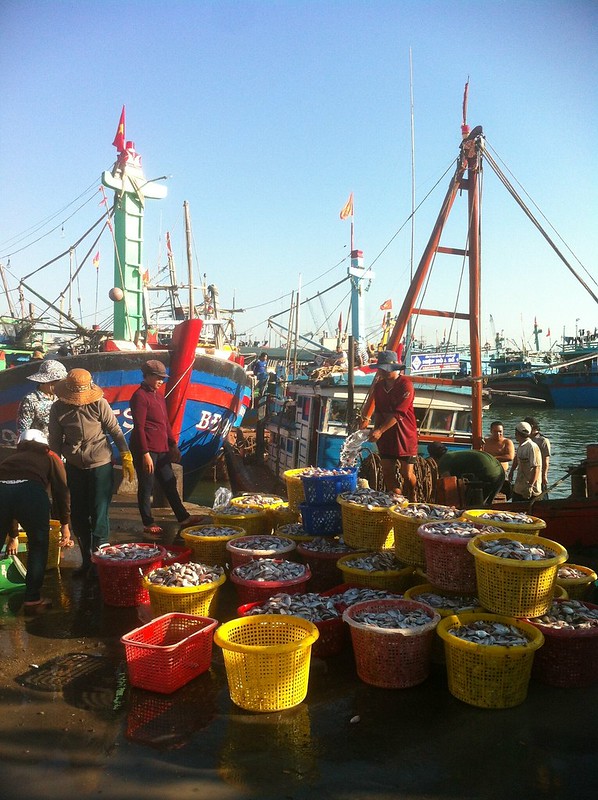
Walking into the port in Quy Nhon was what I imagine it was like to walk into a port 200 years ago. Wooden fishing boats were all crowded around the docks unloading baskets full of fish that were carried off on bicycles or by hand to a covered area 30 feet from the water. There, the fish were cleaned and either set out to dry on reed mats behind the covered area or packed in ice and loaded into trucks. I suppose that last step put us more squarely in the present. There were plenty of wholesale buyers carrying off baskets by hand though, so it wasn’t hard to imagine you were in the 19th century. I think that in a lot of ways, travelling in developing countries is like going back in time. Fishing ports in the west are so mechanized, huge and disjointed that it’s hard to see the whole process - nevermind the fact that a visitor to a western port would unlikely get to just wander around at his leisure among the melee like we did in Quy Nhon.

Despite the chaos, rotting fish smell and a glaring sun before 7am, we were able to see the whole process very neatly and transparently; the way it would be laid out in one of those illustrated encyclopedias of “how things work”. On the other side of that, of course, is that even I, a lay mariner at best, could see obvious ways to improve the port facilities. How about enclosing the fish processing center and refrigerating it to reduce the need to truck ice in on a daily basis? Or even better than that, make the ice on the premises instead of driving it across town? The crudeness of the operation was beneficial to us, but I’m sure the port operators aren’t striving for quaintness. Who knows what the place will look like in 20 years - or if it will even exist - as capital investments improve and complicate the port. That’s why you have to see it now and then compare it to the future when it comes. Actually, I read later that Quy Nhon had been a significant port since the 2nd century AD, so chances are it’ll survive the next 20 years.


After the fishing port, we drove about another mile down the road and found the boatyards. When we arrived, two crews were building two separate fishing boats out of wood. It was amazing to watch the process. Twenty year old boys in plastic shower slippers were scrambling along a make-shift scaffold fitting freshly milled wood planks around the rib of the keel. I’m not the best with boating terms, so forgive me if I slip up. As far as I could tell, the guys were cutting boards about 20 feet long and attaching those planks to the frame of the boat (also wood) using vice grips. Then they drilled holes into the ribs, stuck iron pegs into the holes, and used those pegs as braces to force the wooden planks into place with vice grips. I thought it was cool that they use wooden pegs to attach the outer planks to the ribs of the frame. There was very little metal used in the whole process. In fact, if it weren’t for the electric circular saw and the electric drill, the boatyard scene could have also taken place two centuries ago. The vice grips were key to putting the planks in place though. I’m not sure if vice grips were around in the 19th century. And again, how many boatyards in the west would let you walk around freely, looking over the workers’ shoulders? I’m sure OSHA would not approve.


So, Quy Nhon was a success. It was the kind of place where you can just unpack your bags for a few days and go find an adventure. Compared to China, it was a breeze. People were much more friendly, spoke more English and seemed more open to foreigners. This also made me happy that I spent the time I had in China. Seeing how easy southeast Asia can be, I’m happy we opted for the more challenging route.

By the time I post this, we will have arrived in Saigon and be back in city life. I’m operating under the assumption that Saigon will be just like New Orleans (major port city at the mouth of a major river system; French influence; prostitutes, etc.) and that the only difference will be that songs will refer to the “Mekong Delta Blues” instead of the “Mississippi Delta Blues”.